Highlights
- Conductive fabrics serve as effective flexible Joule heaters for heat-activated soft actuators.
- Kirigami-patterned Thermionyx fabric achieves >30% linear actuation strain.
- Thermionyx withstands up to 195 °C and 30 W power input with repeatable heating cycles.
- Fabric heaters provide more uniform heat distribution than traditional Ni-Cr wire coils.
Abstract
We examine electrically conductive fabrics as conductive heaters for heat-activated soft actuators. We have explored various fabric designs optimized for material properties, heat distribution and actuation/de-actuation characteristics of the soft actuators. We implemented this approach in the silicone/ethanol composite actuators, in which ethanol undergoes a thermally-induced phase change, leading to high actuation stress and strain. Various types of conductive fabrics were tested, and we developed a stretchable kirigami-based fabric design. We demonstrate a fabric heater that is capable of cyclic heating of the actuator to the required 80 °C. The fabric with the special kirigami design can withstand temperatures of up to 195 °C, can consume up to 30 W of power, and allows the actuator to reach >30% linear strain. This technology may be used in various systems involving thermally-induced actuation.
Figures
Figure 1. Fabric Heater in Silicone-Ethanol Thermal Actuator
Optical and thermal images comparing the actuator before and after actuation (left: before/after; right: thermal imaging of heating and fully actuated states).
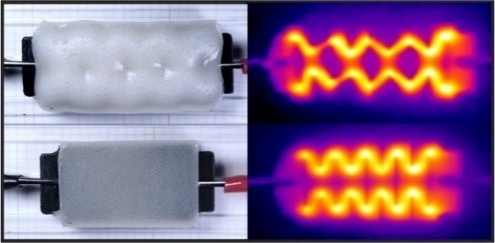
Figure 7. Kirigami Fabric Designs
Thermionyx nonwoven fabric with kirigami cut pattern (KL-6), showing the staggered horizontal cuts that enable mechanical compliance and stretchability beyond 200% of original length.
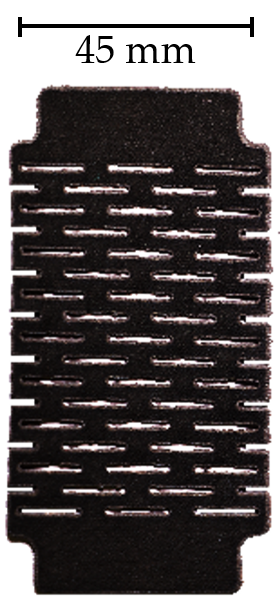
Figure 8. Thermal Images of Thermionyx Fabrics During Heating
Thermal imaging of the blank (KB-6) Thermionyx fabric design during Joule heating, showing temperature distribution. Dashed lines indicate the silicone material boundary; alligator clips appear cooler at top and bottom.
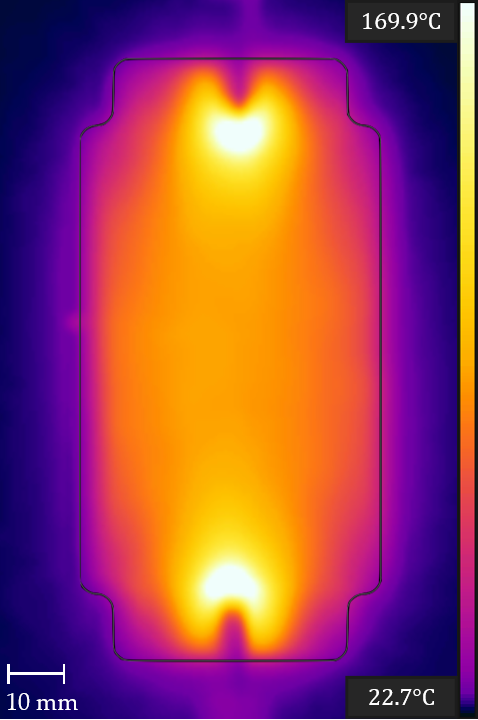
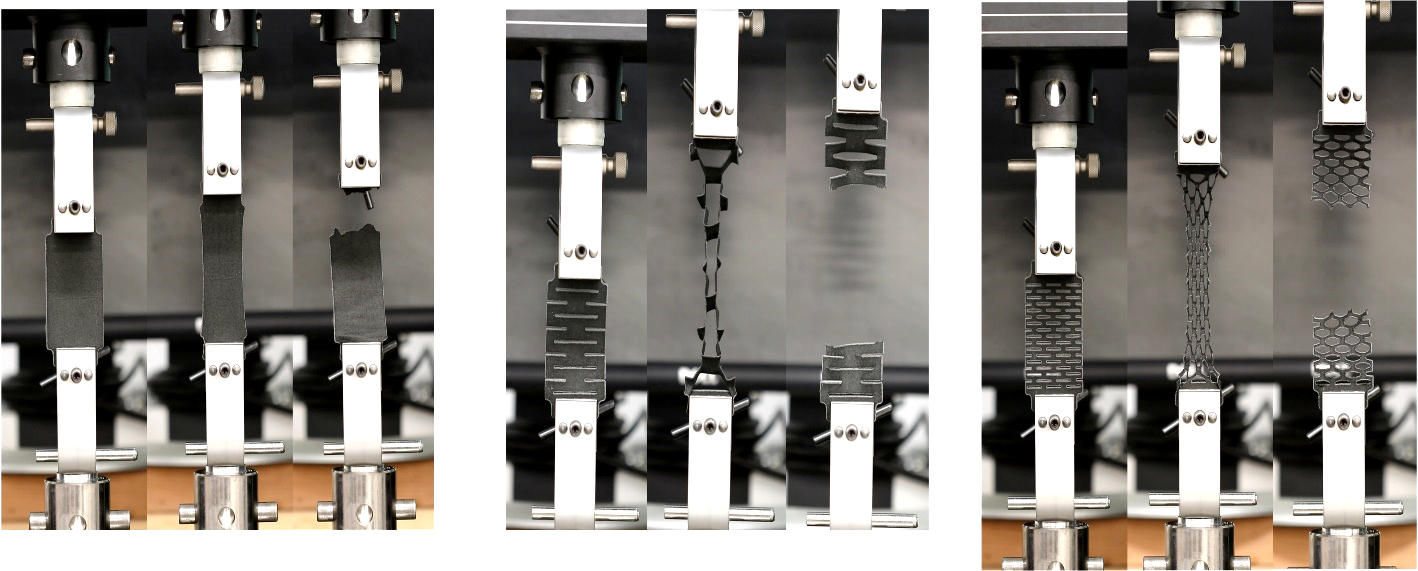
Figure 9. Mechanical Testing and Actuation Results
Tensile test results showing engineering stress vs. strain for KB-6, KL-6, and KS-6 Thermionyx fabric designs. KL-6 and KS-6 kirigami patterns withstand 47.9% and 39.3% more strain than the uncut KB-6 baseline.
Paper
Links
Citation
| |