Highlights
- Overground walking in virtual reality causes small modification of gait.
- Visual perturbations reduce stride length, and increase stride width and variability.
- Effects are greater for medio-lateral compared to antero-posterior perturbations.
- Over time, participants adapt to the virtual environment and the visual perturbations.
Abstract
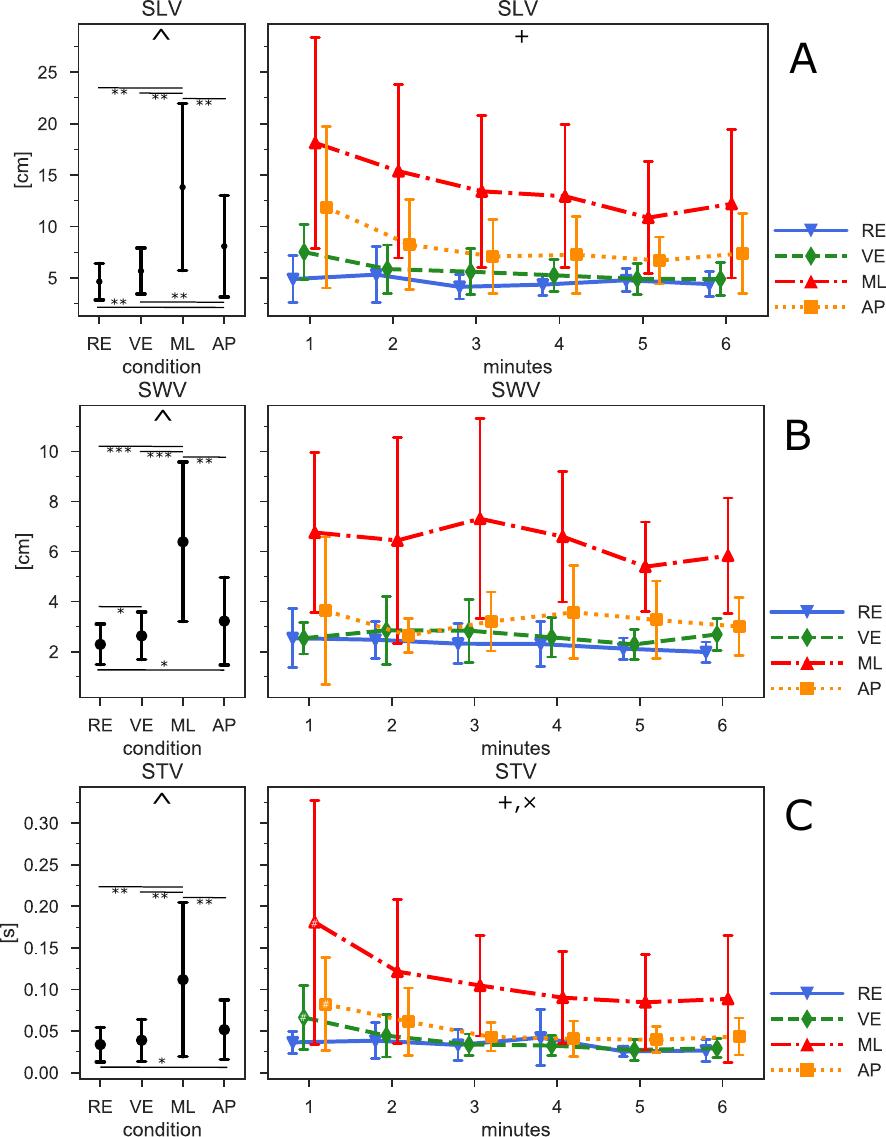
Virtual reality (VR) has been used to study locomotor adaptability during balance-demanding tasks, but little is known about gait adaptations during overground walking. This study investigated how twelve healthy young adults modified and adapted their gait during overground walking in a virtual environment (VE) with continuous multidirectional perturbations of the visual field while wearing a VR headset. Participants walked on an instrumented walkway in four conditions: real environment, VE, and VE with antero-posterior and medio-lateral visual perturbations. Results showed that participants took shorter strides with higher variability in the VE and during perturbations, with medio-lateral perturbations causing greater effects. Over time, participants adapted by increasing stride length and reducing variability. This paper provided first evidence for visuomotor adaptations during overground walking with a VR headset, representing an initial investigation for developing new VR methods for early detection and remediation of gait deficits in ecological conditions.
Figures
Figure 1. Experimental Setup
Schematic of the system (top). Picture of a subject walking with the headset (bottom left). View of the virtual environment (bottom right).
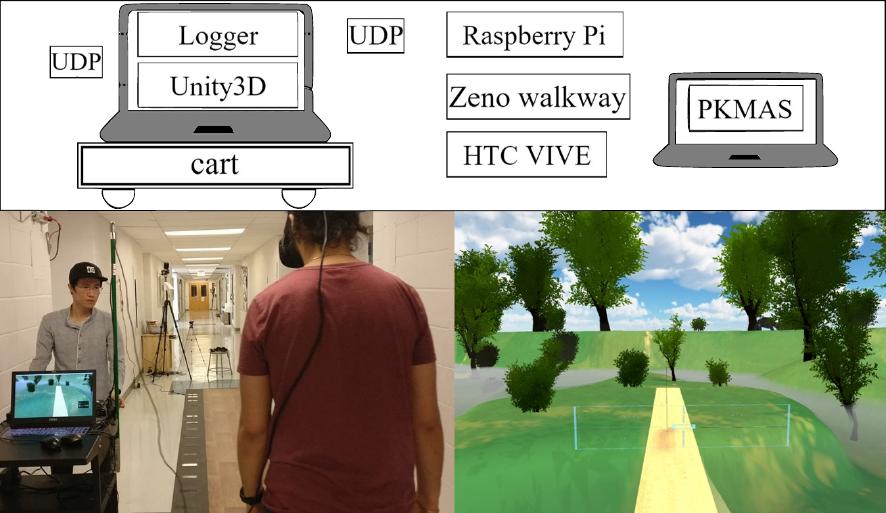
Figure 2. Results: Mean Gait Parameters
Panel A: Stride length (SL). Panel B: Stride Width (SW). Panel C: Stride Time (ST). Left graphs show effect of condition; right graphs show effect of time.
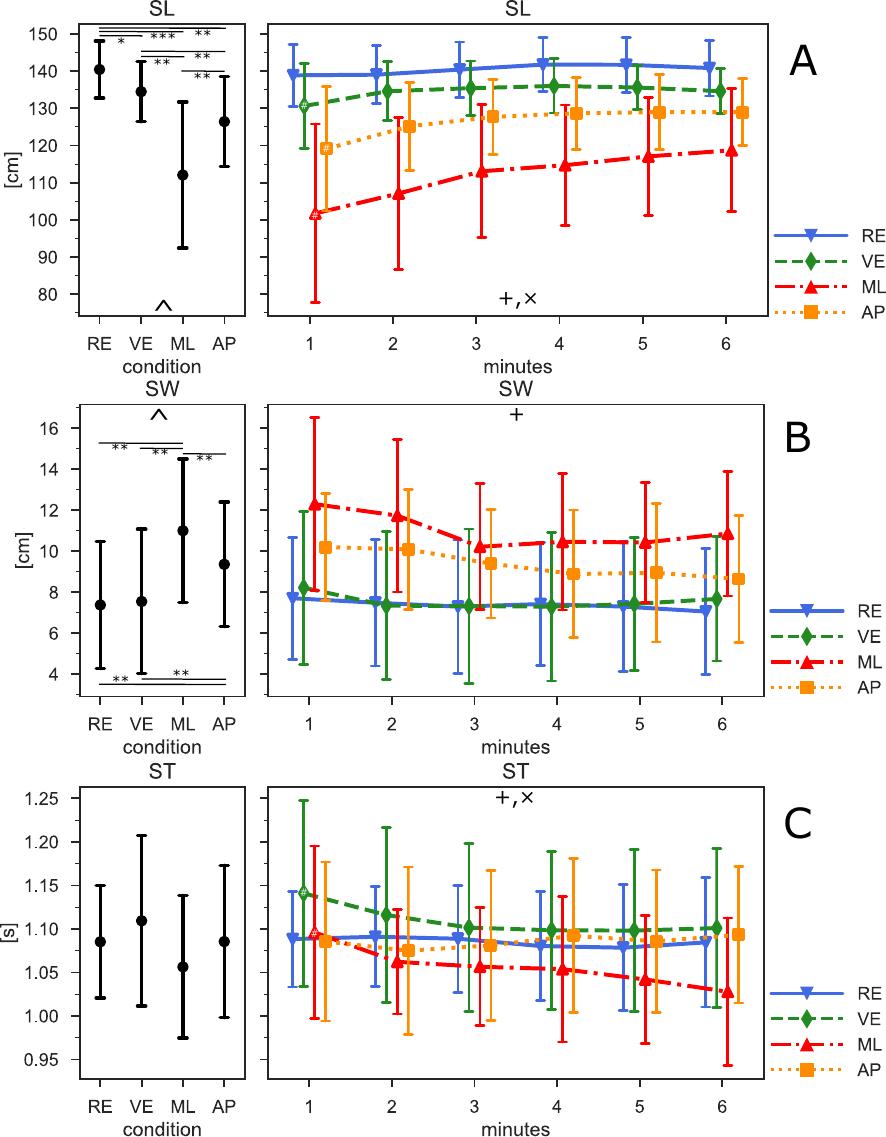
Figure 3. Results: Gait Variability
Panel A: Stride length variability (SLV). Panel B: Stride Width Variability (SWV). Panel C: Stride Time Variability (STV). Left graphs show effect of condition; right graphs show effect of time.
Paper
Links
Citation
| |