Abstract
This study presents the development of a virtual reality version of the floor maze test (VR-FMT), a navigational assessment for evaluating spatial navigation through an unfamiliar two-dimensional floor maze. Fifty-five healthy adults completed the floor maze test in three conditions (real environment, virtual environment without walls, and virtual environment with walls) and two neuropsychological tests. The study examined how distal visual cues affect maze navigation performance and correlations with executive function. Results showed that the VR-FMT provides an ecologically valid environment for assessing spatial navigation abilities and correlates with executive function measures. This work offers potential applications for early detection and remediation of cognitive and navigational deficits in clinical populations.
Figures
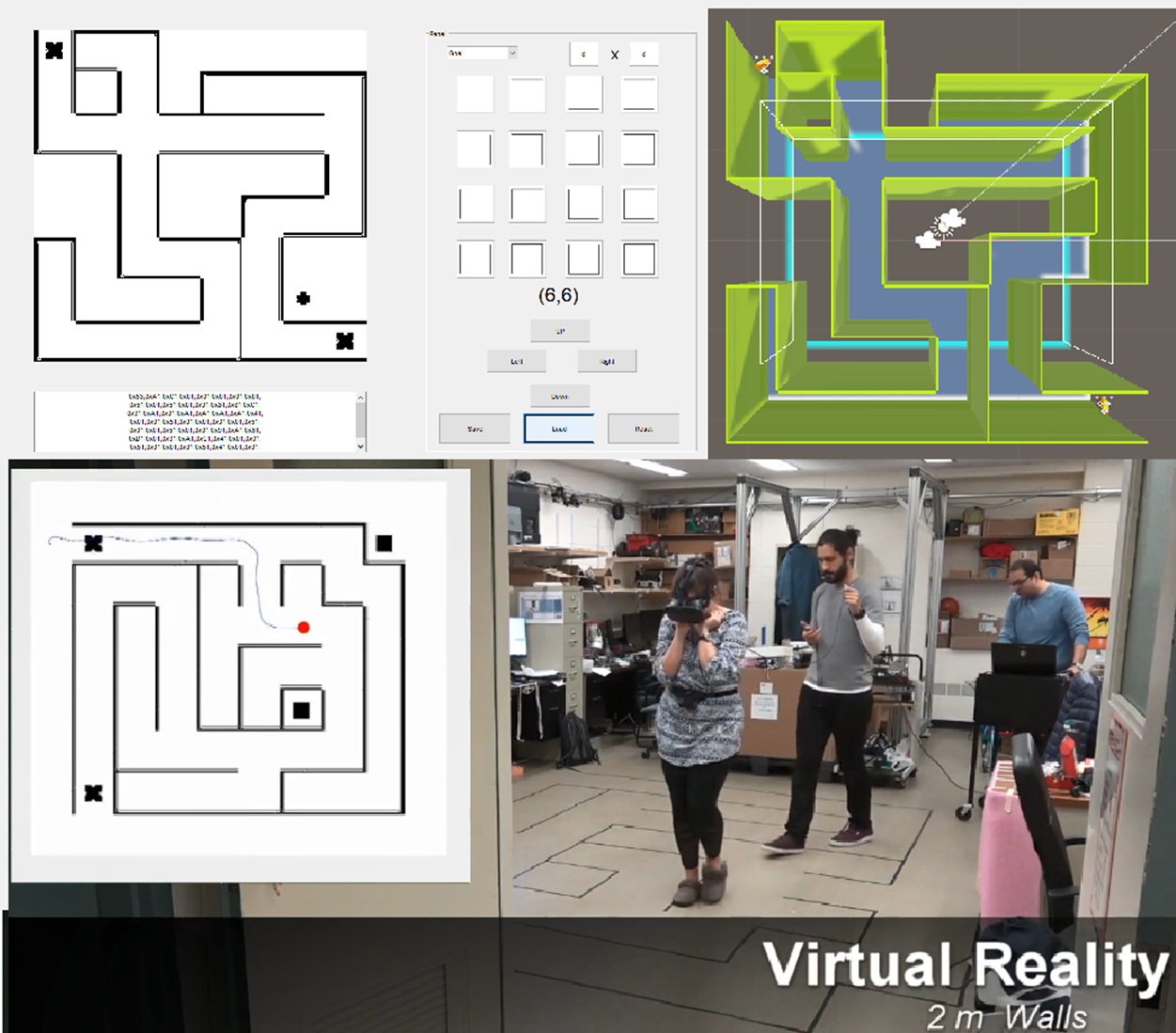
Figure 1. Experimental Setup Left Panel: Matlab user Interface to build the plan of the maze. The maze can be built by allocating up to 16 types of blocks. Each block allows to build walls in different directions and positions. The software allows for deciding the size and the number of blocks to insert in the maze. Once created, multiple maze plans can be saved and loaded for future uses. Right Panel: Top view of the plan of the Maze used in this experiment. Bottom Panel: Picture of a subject walking with the VIVE headset in the virtual maze with 2 m walls. The virtual maze was mapped one to one with the real maze.
Paper
Links
Citation
| |