Abstract
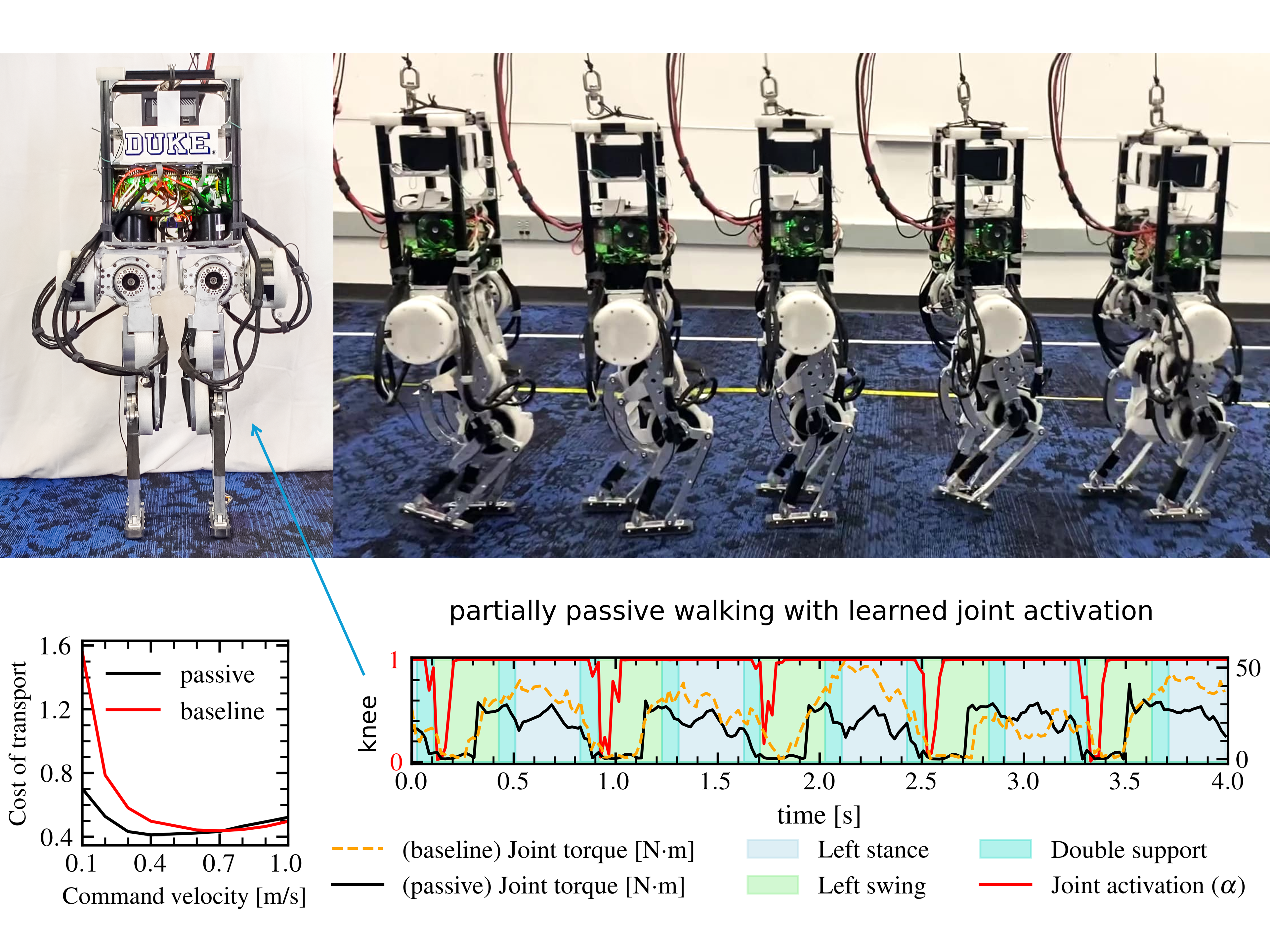
We present the Duke Humanoid, an open-source 10-degrees-of-freedom humanoid, as an extensible platform for locomotion research. The design mimics human physiology, with symmetrical body alignment in the frontal plane to maintain static balance with straight knees. We develop a reinforcement learning policy that can be deployed zero-shot on the hardware for velocity-tracking walking tasks. Additionally, to enhance energy efficiency in locomotion, we propose an end-to-end reinforcement learning algorithm that encourages the robot to leverage passive dynamics. Our experimental results show that our passive policy reduces the cost of transport by up to 50% in simulation and 31% in real-world tests. Our website is https://github.com/generalroboticslab/DukeHumanoidv1.
Graphical Abstract
Video
Paper
Poster
Links
Citation
| |